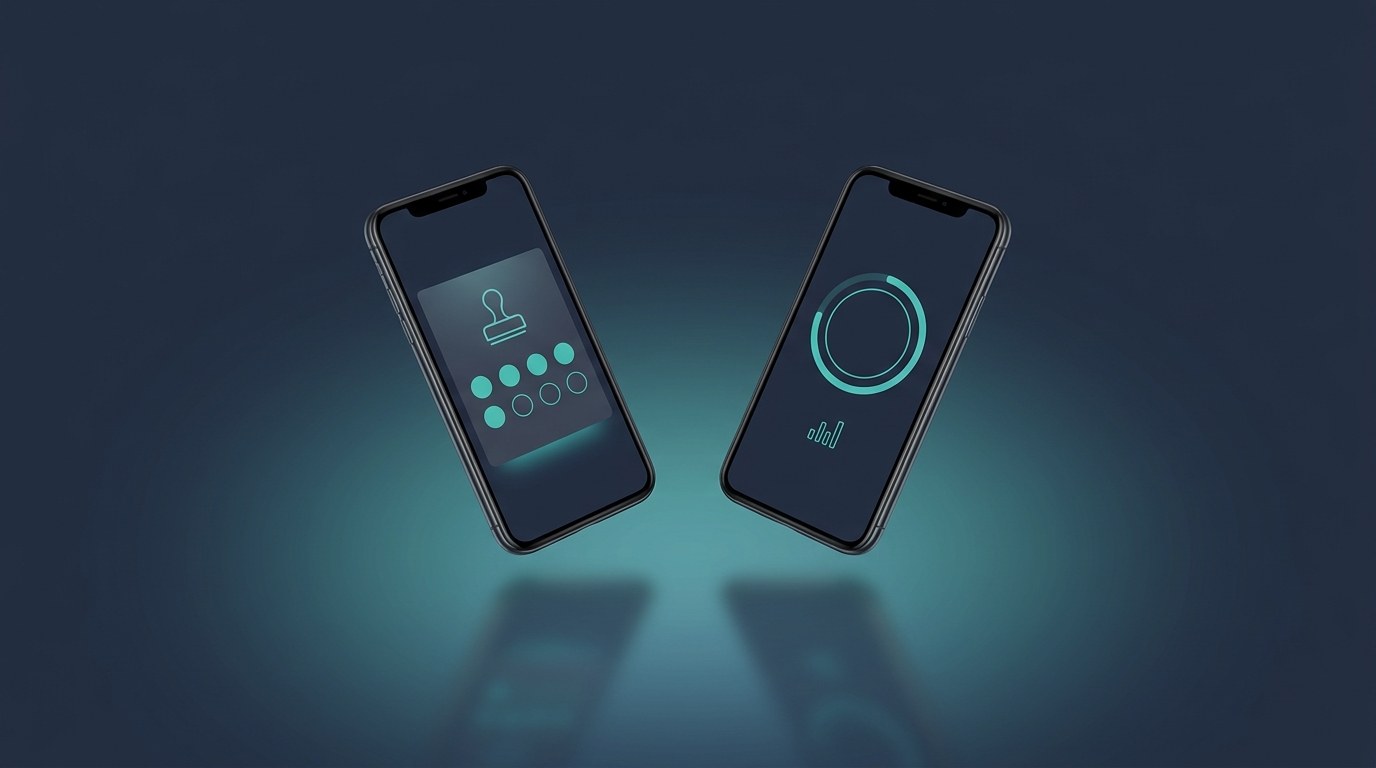
Every loyalty program starts with the same fork in the road: points or stamps? It sounds like a small design choice, but the loyalty points vs stamp cards decision shapes everything that follows — how fast customers understand the program, how often they come back, and how much time your team spends explaining the rules at the counter. The good news is that the right answer isn't a matter of taste. It follows directly from two things you already know about your business: how often your customers visit, and how much their spend varies when they do. Get those two questions right and the choice almost makes itself.
How Each One Actually Works
A stamp card (or punch card) rewards visits. Buy a coffee, get a stamp; the tenth coffee is free. The rules fit in one sentence, the progress is visible at a glance, and the reward is always a fixed number of visits away. On a digital stamp card in Apple Wallet or Google Wallet, the customer literally watches the circles fill up.
A points program rewards spend. Every dirham earns points; points add up to rewards the customer chooses — a discount, a free product, a tier upgrade. It's the model the airlines and supermarket chains run, and it's more flexible: a customer who spends 300 AED earns three times what the 100 AED customer earns, which a stamp card can't express.
That flexibility is the trade-off. Points need an exchange rate ("how much is a point worth?"), a catalogue of rewards, and a customer who's willing to do a little math. Stamps need none of that — which is exactly why they work where they work.
Loyalty Points vs Stamp Cards: Two Questions That Decide It
1. Is the purchase repeatable and roughly the same each time? If your customers buy more or less the same thing on every visit — a haircut, a flat white, a car wash, a manicure — stamps win. The visit itself is the behaviour you want to reward, and "buy 9, get the 10th free" is understood in the time it takes to scan a QR code. This is why salons, coffee shops, and car washes run on stamp cards: the frequency is there, the ticket size barely moves, and simplicity beats precision.
2. Does spend per visit vary a lot? If one customer leaves your shop with a 40 AED basket and the next with a 400 AED one, a stamp per visit treats your best customer like your smallest. That's when points earn their keep: reward the dirham, not the door. Retail boutiques, pharmacies, and restaurants with a wide menu and group tables usually land here — the family iftar for twelve should count for more than a solo karak.
A useful shortcut: stamps reward frequency, points reward value. Pick the one that matches the behaviour you most want to change.
Where Each One Quietly Fails
Stamp cards fail when the reward is too far away. Ten stamps for a service customers buy four times a year means a two-and-a-half-year wait — nobody finishes that card. Keep the finish line within six to eight typical visits, or add a small halfway reward so progress never feels stalled.
Points programs fail from complication. If a customer has to ask "so what do I actually get?", the program is already losing. Vague exchange rates, expiring balances with no warning, and rewards that need 40 visits to reach are the classic loyalty program mistakes — and they're all self-inflicted. If you choose points, publish one plain sentence: "Every 10 AED earns a point; 100 points is 25 AED off." If it doesn't fit in a sentence, simplify until it does.
And both models fail the same way on paper or in a standalone app: the card gets lost, the app gets deleted, and the program dies quietly. Whatever you choose, it should live where customers already look — not in an app they have to download, but in the wallet that's already on their phone.
You Don't Have to Choose Forever
Here's what the airlines-vs-coffee-shop framing misses: on a wallet pass, the two models are closer than they look. A stamp is just a point with a picture. Plenty of businesses start with a stamp card because it's the fastest thing to launch and explain — you can replace a paper punch card in an afternoon — then evolve: a second stamp for visits over a spend threshold, a bonus stamp on quiet weekdays, or a full switch to points once the program has regulars and data. Because the card updates itself in the customer's wallet, changing the rules doesn't mean reprinting anything or apologising at the counter.
Whichever model you run, the mechanics that make it work are the same: customers join in one scan from a QR code, the card sits in Apple Wallet or Google Wallet next to their bank cards, every stamp or point updates in real time, and you can put a message on their lock screen when they've gone quiet. The model is a decision; the delivery is what does the retaining. Our 7-step launch checklist walks through the rest of the decisions once this one's made.
The Takeaway
Points vs stamps isn't a debate to win — it's a diagnosis. Same purchase every visit, high frequency: stamps, with a reward six to eight visits away. Varied basket sizes, spend worth rewarding: points, with rules that fit in one sentence. Either way, put the card in the customer's phone wallet, make joining a ten-second scan, and let the lock screen do the reminding. The businesses that get loyalty right aren't the ones with the cleverest earning scheme — they're the ones whose card is still on the phone, still visible, and still filling up six months in.
Ready to launch either one? Book a quick demo with Wally — we'll set up your stamp card or points card for Apple Wallet and Google Wallet, and your first customers can join with one scan this week.